

A freelancer’s portfolio is their best asset to convert clients. It’s a fact that we already went over in our freelancer’s starting guide. However, it’s worthwhile to go even further. The portfolio is a summary of a freelancer’s career. It’s a compressed version of the projects the freelancer has undertaken over the years. An actual digest of their career.
As such, the freelancer’s career becomes their best application letter. For experienced freelancers this may sound like a given. But, for the ones starting out, let’s give a reminder of the importance of knowing how to choose their projects and how to organize their freelance portfolio.
Table of Contents
The right mindset: freelancers should choose as much as they are chosen
First, an important reminder. You just stop thinking that “beggars can’t be choosers”. It’s certain that a lot of West-African freelancers have a tendency of accepting any type of offer that comes their way.
And it’s common for some clients to target those freelancers specifically since they are less demanding and a lot more tractable. If we consider that living costs are lower and that freelancing opportunities are harder to come by, then the great majority of freelancers really settle for whatever they can land.
The ambition and will to land better freelancing contracts is intact. However, these ideals collide with reality. It’s a fact and it’s a reality I also grapple with, in some aspects of my freelancer career.
Nonetheless, the only way to kickstart your freelancer career is to be a lot more selective regarding the offers you accept. Without fail, a time comes when the independent contractor is no longer obligated to accept all the offers they come across. At this point, intentional choices become the best way of sculpting a freelancer career history and a portfolio that make a difference.
The main takeaway is to put as much care into choosing your clients and projects, as they put into choosing freelancers to entrust with their tasks. After all, the freelancer interview is a two-way street.

Freelance jobs: aiming for consistency and growth
In order to pick and choose freelance jobs, some criteria need to be implemented. Whatever your field of work may be, these criteria will allow you to build a freelancer career history that impresses and reassures.
First of all, you must aim for continuity. As a freelancer, it’s common practice to showcase a wide range of skills to maximise the chances of getting freelancing opportunities. For example, I present myself as an SEO content writer, as well as an English to French translator and subtitler. Over the years, this has allowed me to establish myself, but it’s also a hurdle when I’m looking to get more specialized roles that also pay better.
“Jack of all trades, Master of none”… To sum things up, it’s important to target a specific set of skills and set up an efficient freelance profile around that expertise. In practice, I have started guiding my search toward offers that better fit this specific profile. Jobs likes subtitling have fallen to the background and are mostly neglected for the benefit of copywriting and SEO writing opportunities. In this context, pay is not the main criteria. More often than not, the potential for continuity makes the scales tilt.

freelancer career continuity: following through
“You must braid the new rope at the end of the old one”. This philosophy governs the notion of continuity for a freelancer’s career. Unlike most traditional careers where longevity in a professional role is generally rewarded, freelancers are obligated to always look for better pastures.
In this respect, freelancers adopt the same tools and skills as professionals who aim for career mobility above all else. In other words, curating a professional career history that can become their ultimate freelance application letter.
For instance, an experienced SEO writer who thinks they have hit a ceiling are faced with various options. They can search for jobs that pay better, but with no guarantee that this opportunity will provide stability or lead to better jobs.
Another option would be to look for jobs in copywriting. It’s a neighbouring field of work where they can make inroads. But to ensure a successful migration, they need to stay close to the fields where their skill sets shine. Applying to subtitling jobs or a customer service role that pays well can be tempting. But these opportunities will not lend any weight to their freelancer profile.
Conversely, looking for opportunities in marketing, translation or even emailing will better serve their ambitions in the long run. In short, continuity is about staying the course. All jobs are not worthy of your time. In particular when they don’t contribute to building a consistent picture of your skills and ambitions as a freelancer.
That being said, the reality and momentary constraints can always trump ideal parameters.
Growing thanks to your freelance clients
It is no secret that networking as a freelancer is required to grow your career. One must show their ability to be seen and their ambition to rise higher. When it comes to freelancer careers, the tools and skills can be a little different.
Sure, there are a lot less company diners and “team bonding” experiences. But, one learns quite fast to keep in touch with old clients and to launch their own website to serve as a professional showcase.
Growing often means using professional contacts as a growth lever. Whenever they connect you with colleagues who require your services ; whenever they know of an upcoming project that could use your skills, and so on…
It’s an essential know-how for a freelancer career. It’s a guarantee for a steady stream of qualified freelance jobs and growth opportunities for a freelancer’s career.
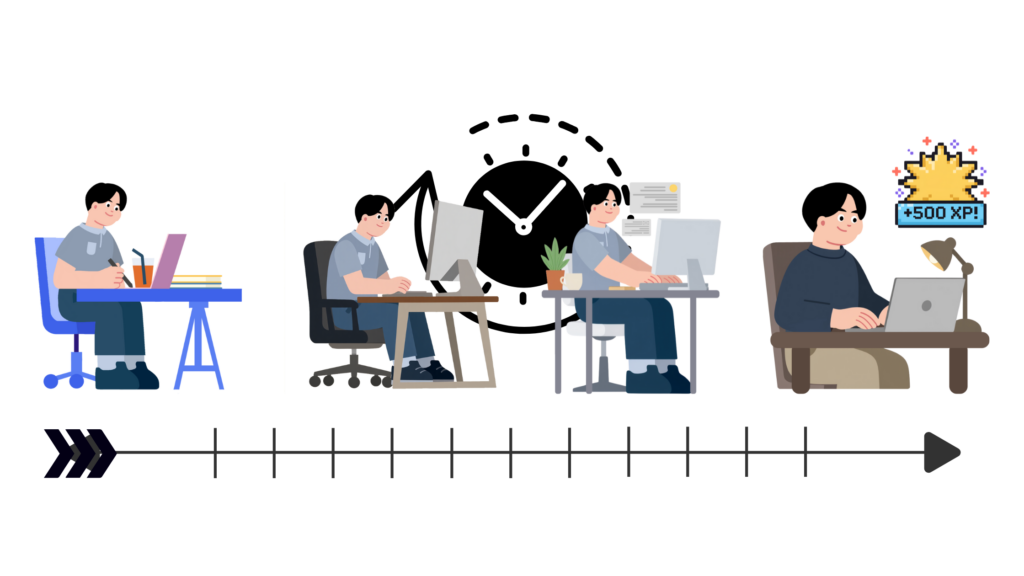
Organizing the freelance portfolio: the good, the mediocre and the bad
On paper, curating one’s freelancer career history is easy. But as is often the case, things are not always so simple in reality. This is where the freelancer needs to know how to filter the good, the less good and the professional experiences that could harm their freelancer profile.
Specifically, they need to learn how to organize and showcase their portfolio so that it can be a good and flattering depiction of their freelance history.
For instance, right at this moment, my freelance profile only shows one project in my portfolio. In order to present a more specialized picture, projects relating to subtitling or one-off translation projects were hidden away. In their place, I have only kept the most recent projects, the high quality projects and this current website in my portfolio.
Good projects are the ones that can prove your skills and better orient the clients when going over your profile. In my case, this bilingual website about freelancing that I have been optimizing for SEO is a good element. It’s a good asset for my freelance profile as an SEO content writer and English to French translator.
Other less useful elements could be older translation and writing projects. All in all, it’s better to give priority to recent projects and the ones who have a bigger scope and scale.
On the other hand, elements like one-off tasks or jobs that don’t fit your preferred scope of competence should be hidden away.
Conclusion
The best way of curating your freelancer career history is to think of it as a long term project. Like any project, your professional career as a freelancer requires planning, preparation and utmost diligence. Knowing which offers to accept or refuse is an essential skill to guide your professional project toward the expected outcomes. But, it’s just as important to be flexible and know how to adjust whenever the project is derailed. Turn your freelancer career history into the perfect portfolio to propel your profile to new heights.
The illustrations on this page were made in Canva.